Research Projects
Exo-Muscle: a semi-rigid knee assistive device
Semi-rigid actuation for the knee joint
PhD work · 2019–2023A chain that switches between rigid and flexible, so the tendon always knows where to go.
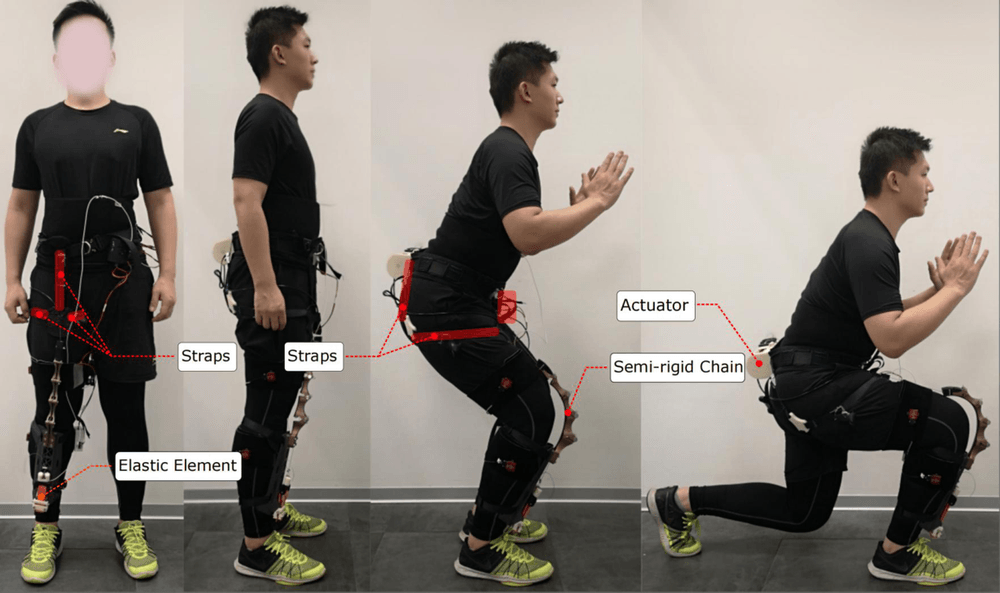
The problem. Rigid knee exoskeletons assume a fixed centre of rotation, but the human knee joint translates its axis as it flexes. The resulting misalignment generates undesired constraint forces and discomfort. Soft, tendon-driven exosuits avoid the misalignment by being inherently compliant, but their routing path varies with the motion, so the moment arm around the joint is not well defined and the delivered torque is not deterministic.
The approach. Exo-Muscle explores a semi-rigid principle that keeps the advantages of both. A segmented chain wrapped around the knee joint changes its mechanical state with the flexion angle: it forms a rigid, well-defined guide for the transmission tendon while still adapting to the translation of the knee centre of rotation. A series elastic element in the drive train absorbs impacts and provides passive load compensation, and a strap routing scheme distributes the reaction load onto load-insensitive areas of the limb rather than onto the joint itself.
The implementation. The device is actuated by a tendon routed through the semi-rigid chain, with the assistive torque regulated online through a knee torque estimation and tendon force control scheme.
- 38 Nmmaximum assistive torque delivered to the knee joint
- 2.5 kgtotal prototype weight: calf module (0.85 kg), actuator module (1.3 kg), and Bowden tendon transmission and attachments (0.35 kg)
- Deterministictorque, insensitive to donning inaccuracies
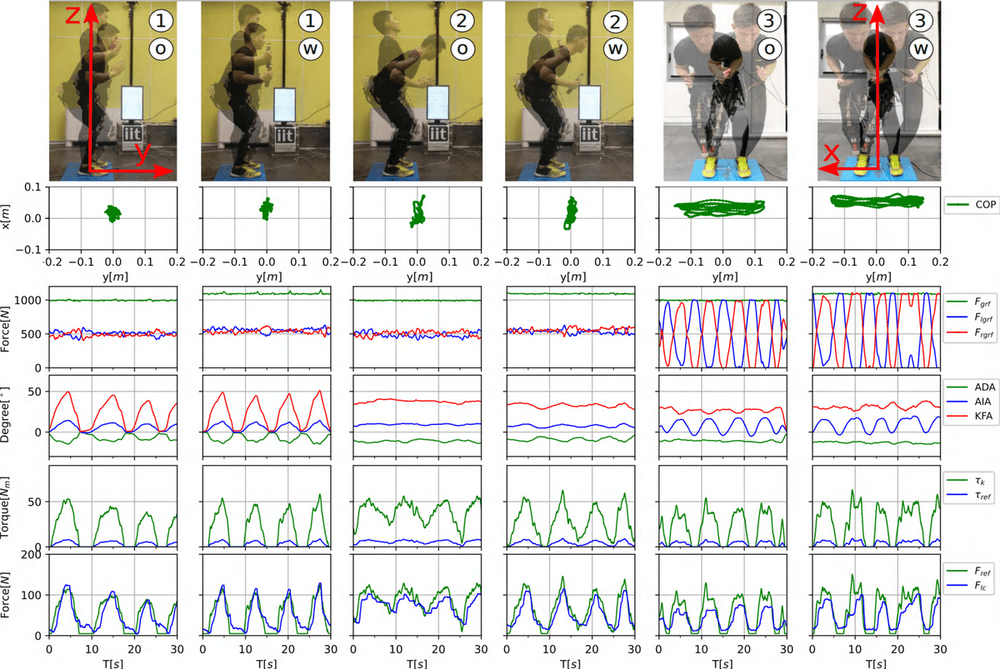
Related publication: Exo-Muscle: A Semi-Rigid Assistive Device for the Knee, IEEE RA-L, vol. 6, no. 4, pp. 8514–8521, 2021. DOI · Publications
Calibration, fault detection and recovery for a force-sensing device
Trustworthy ground reaction force measurement
2023–2024A learned calibration is only useful if it survives a broken sensor.
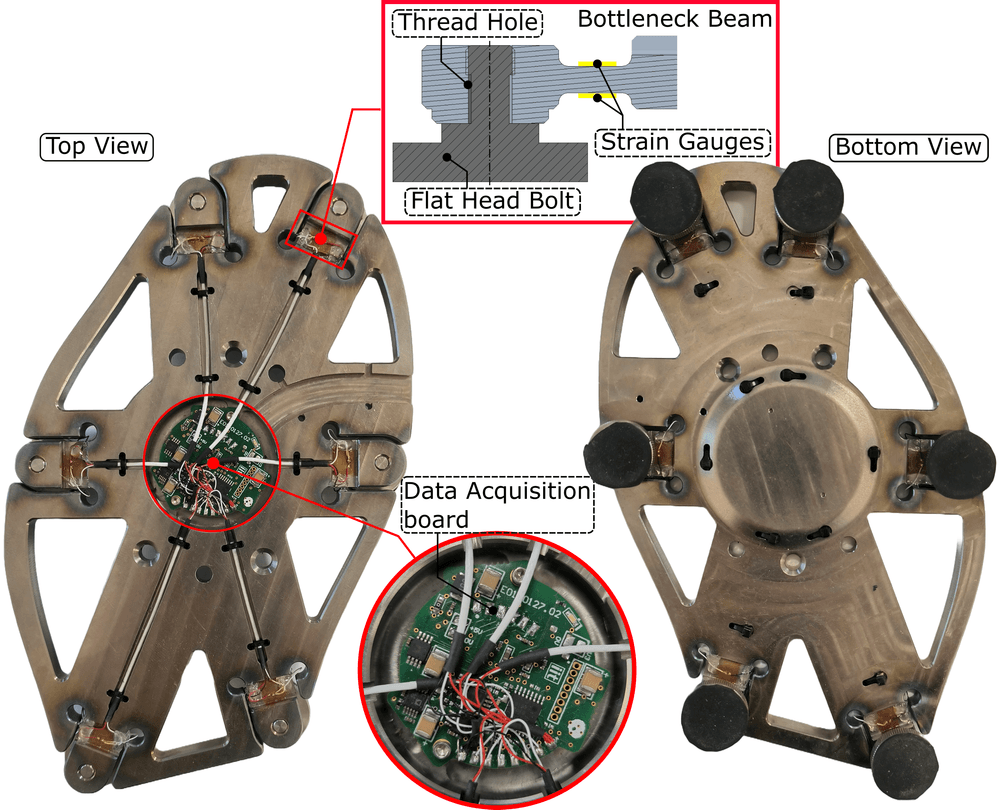
The problem. Ground reaction force information — centre of pressure and vertical ground reaction force — underpins gait assessment, prosthesis and exoskeleton control, and balance in legged robots. Wearable force insoles and soles make the measurement mobile, but many lack a deterministic physical model to convert raw readings into accurate forces, so learning-based calibration is used instead. These models are only valid inside their training distribution: a single sensing element returning an abnormal reading can push the estimate far outside it, producing a corrupted force estimate that a controller may then act on.
The approach. The work starts with a newly developed force-sensing device, and a model-free calibration built on Gaussian process regression that extracts centre of pressure and vertical ground reaction force from raw sensor data. It then adds a GPR-based fault detection network that evaluates the sensing state of individual elements, and a GPR-based recovery model that reconstructs the estimate once a fault is identified, so the device keeps functioning rather than failing silently.
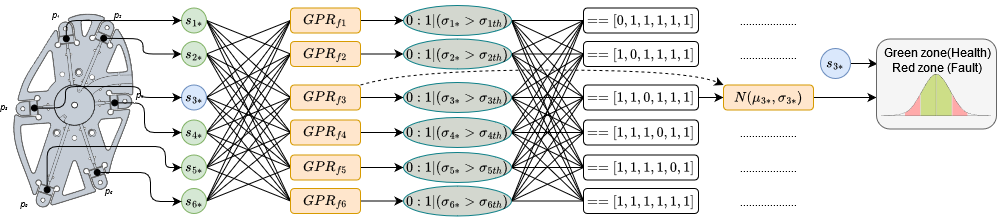
Results. Validation experiments analyse the effect of the detection threshold's scale factor. The fault detection network reaches over 90% success with less than 5 seconds average delay when the scale factor lies between 1.68 and 1.90, and engaging the recovery models substantially improves estimation accuracy under fault conditions.
- 0.024NRMSE for vertical ground reaction force
- >90%fault detection success, under 5 s average delay
- 85.0%COP accuracy improvement after recovery
- 84.8%vGRF accuracy improvement after recovery
Related publication: On the Calibration, Fault Detection and Recovery of a Force Sensing Device, IEEE RA-L, vol. 9, no. 11, pp. 9271–9278, 2024. DOI · Publications
Passive parallel elastic actuation for legged robots
A gas spring and an optimised cam
2023–2024Making a passive spring produce an arbitrary compensation profile.
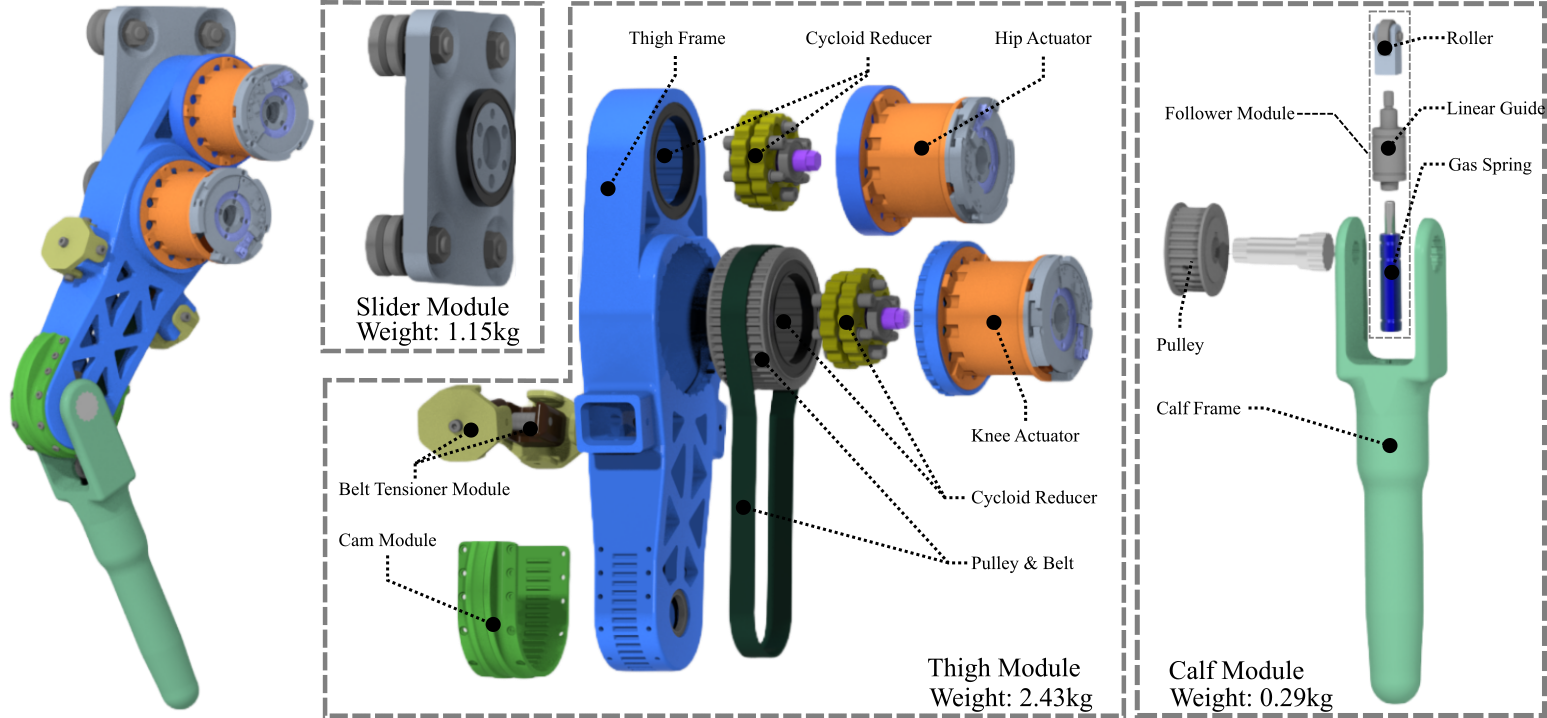
The problem. Legged robots need high torque to hold bent postures — a static squat, or the crouched stance of a wheeled-legged platform. Increasing the gear ratio to get that torque costs backdrivability, transparency, and reflected inertia, while low gear ratios burn energy just to hold static loads. Passive elastic elements can carry the gravitational torque, but a conventional spring has few design parameters, so its torque profile rarely matches the one the joint actually needs. Switches and clutches only give a binary engagement.
The approach. The proposed parallel elastic actuation couples a nitrogen gas spring to a cam roller module. The cam shapes the transmission between the spring and the joint, so the compensation profile becomes highly customisable, and an optimisation-based design procedure derives the cam profile that best matches the desired torque. A gas spring is used rather than a coil spring because it offers higher power density for the same size, and easier installation and maintenance. The same optimisation machinery also drives a spring selection method that identifies which gas spring specification best fits the design requirements.
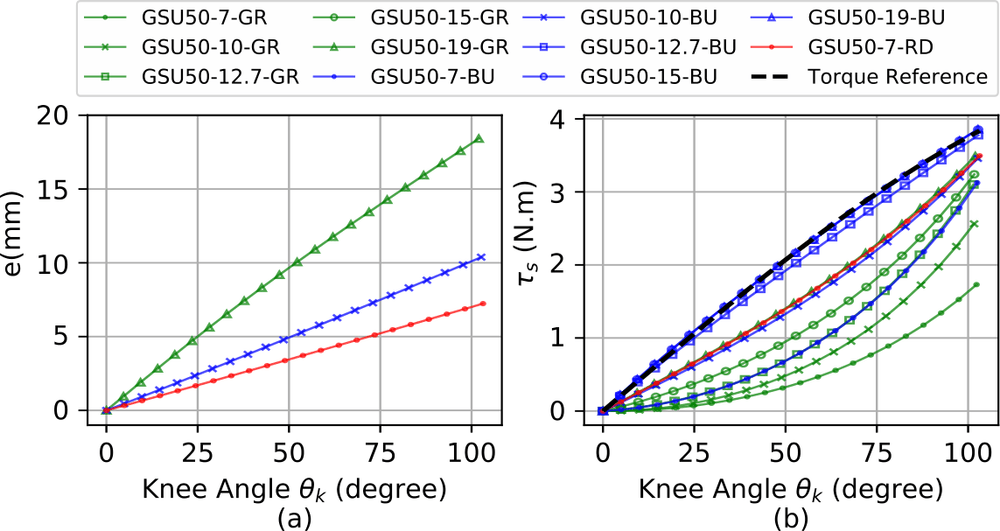
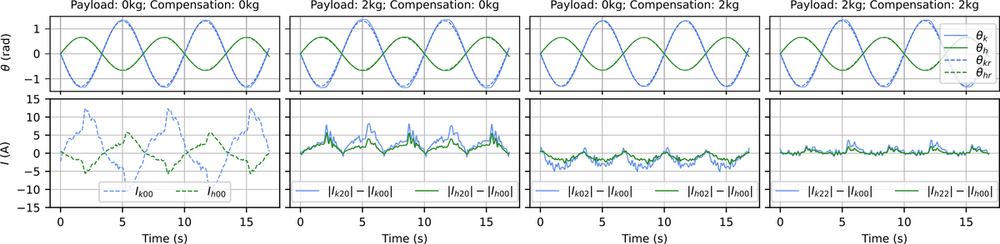
Validation. The mechanism was integrated into the knee joint of a two-DoF monopedal robot actuated by cycloid actuators and evaluated experimentally. The integrated system is compact, easy to integrate, and able to generate nonlinear compensation profiles on demand.
- 71.92%reduction of the extra energy consumption caused by a payload
- High power densityprovided by the integrated gas spring
- Highly designable and optimizablefor nonlinear compensation
Related publication: A Novel Passive Parallel Elastic Actuation Principle for Load Compensation in Legged Robots, IEEE RA-L, vol. 9, no. 10, pp. 8881–8888, 2024. DOI · Publications
Muscle fatigue-aware control without EMG
Assistance that adapts to fatigue, not to a fixed setpoint
2023–2025EMG is needed to train the model, never to run it.

The problem. Muscle fatigue is a leading contributor to work-related musculoskeletal disorders, and wearable devices can reduce it. But surface EMG, the usual way of sensing fatigue, is fragile in daily use: its accuracy depends on electrode placement, skin sweat, body hair, and motion artefacts. Most devices also deliver a fixed assistance level, which wastes energy when the user is fresh and under-supports them as fatigue accumulates. Many controllers that do react to fatigue use a binary threshold, which is abrupt and uncomfortable in an augmentative exoskeleton.
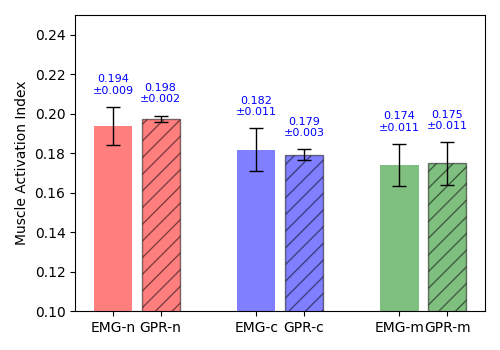
The approach. A muscle fatigue-aware controller (MFAC) separates calibration from operation. In an offline phase, Gaussian process regression learns the relationship between joint moment and angle and the muscle activation measured by EMG. Online, the trained model estimates activation from joint states and the ground reaction forces already measured by the device, so no EMG electrodes are needed during use. The estimated activation feeds a model-based fatigue evaluation module, and the resulting fatigue state enters an adaptive controller formulated within a predictive control framework. Assistance varies continuously with fatigue rather than switching on at a threshold.
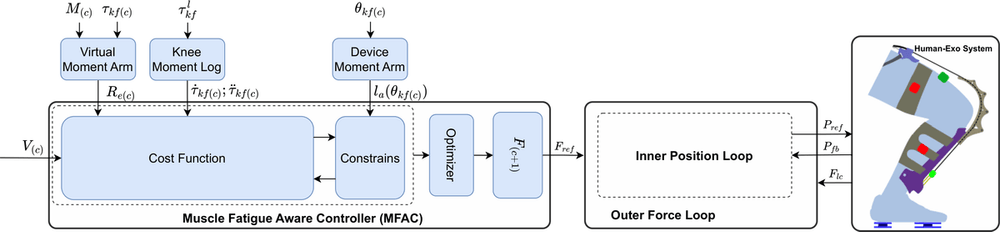
What it buys. Analysing actuator power output shows the intended adaptivity: the controller conserves energy while fatigue is low and progressively raises power output as fatigue grows. For a device with a fixed battery capacity, that translates directly into a longer operating time, and it keeps the sensing complexity of the exoskeleton unchanged.
- EMG-freeonline operation; EMG used only for offline calibration
- Continuousassistance modulation instead of binary switching
- Fatigue-awarepower output tracks the estimated fatigue state
Related publication: Muscle Fatigue-Aware Controller for a Semi-Rigid Knee Exoskeleton, IEEE T-ASE, vol. 23, pp. 44–58, 2026. DOI · Publications